

Why your Meta Ads get leads but no sales in Kerala
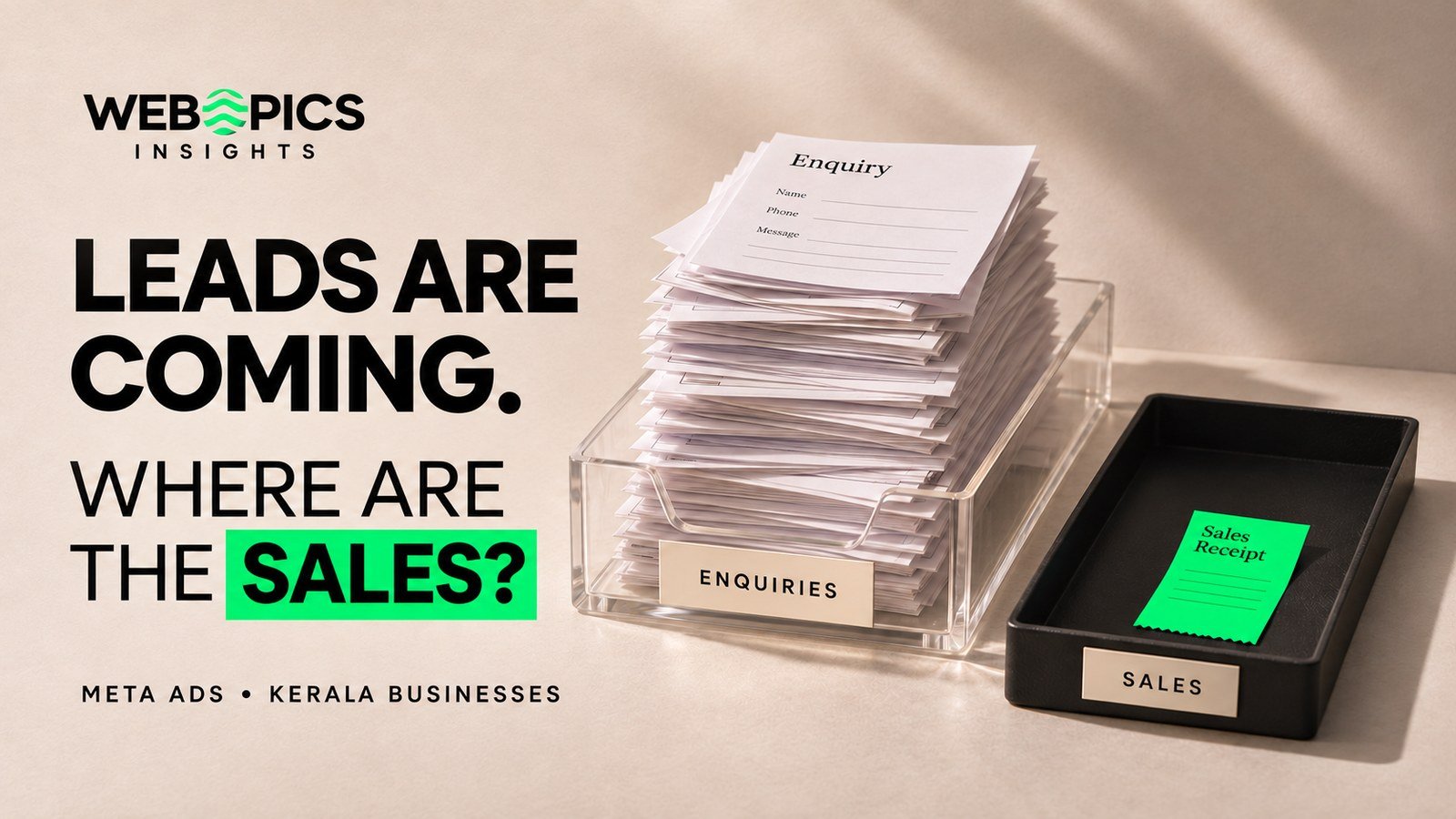
The enquiry sheet is full and the sales register is quiet. Before you blame the ads or the sales team, find out where people are actually stopping. Five stages sit between a submitted form and a paying customer, and most businesses only measure the first and the last. Measure the three in the middle for two weeks and the problem usually identifies itself.
The five stages most businesses never separate
When someone says "we got 200 leads", they mean 200 forms. That number hides four later stages, each of which can leak.
- Submitted. Someone completed the form. That is all it means.
- Contactable. You reached a real person. Wrong numbers and people who do not answer after three attempts drop out here.
- Qualified. They are in your service area, want something you sell, and can spend roughly what it costs.
- Appointment. A showroom visit, a site visit or a scheduled call actually happened.
- Customer. They paid.
A campaign can look excellent at stage one and fail at stage three. Without the middle numbers you are guessing, and guessing usually ends with the ads blamed when the real loss was a phone nobody answered on Sunday.
Find your leak
Work down this table until a row sounds like your business. Check the evidence column before changing anything.
| Symptom | Likely cause | Evidence to check | First thing to test |
|---|---|---|---|
| Leads from outside your service area | Targeting radius, or the ad never says where you operate | Lead locations against your delivery or site-visit range | Name the service area in the creative, then tighten the radius |
| Everyone asks only for the price | The ad gave a reason to enquire but no sense of cost | First message in your WhatsApp threads | Put a genuine starting price or range in the ad |
| Budgets far below your minimum | Creative is attracting a different segment entirely | Quoted value against your average order | Show work at your actual price point, not entry-level items |
| Numbers ring out or do not exist | Accidental submissions, or a form that needs no thought | Contactable rate, and time between ad click and submission | Switch the instant form to the higher intent type, which adds a confirmation step |
| People say they never enquired | Form auto-filled and submitted in one tap | How many submissions used only prefilled fields | Add one typed question the person must answer themselves |
| Leads go cold before anyone calls | No owner for first response, or slow follow-up | Time between submission and first contact attempt | Name one person per day and set a response target |
| Good enquiries, no appointments | The sales conversation is not asking for the visit | Listen to five recent calls | Script a direct ask with two specific time options |
| Everything looks fine but sales are flat | You are judging too early for your sales cycle | Days between first enquiry and payment on your last ten sales | Wait one full cycle before concluding anything |
Let the creative do the filtering
Qualification is cheaper in the ad than on the phone. Every detail you add removes people who were never going to buy, which lowers your lead count and raises the value of what remains. Three things qualify hardest: where you work, what the job involves, and roughly what it costs.
A furniture showroom. An ad showing a sofa with no price attracts everyone. An ad showing the same sofa with a genuine starting price and the delivery range attracts fewer people, and the ones who come have already accepted both numbers.
An interior design business. "Interior design services" invites anyone. Naming the scope, such as full-home interiors for three and four bedroom houses with a realistic starting figure and a typical project length, filters out the person wanting one wardrobe quoted.
A construction company. Plot size, project stage and whether approvals are in place matter more than a brochure shot. Someone still choosing land is twelve months from signing. That is not a bad lead, but it should not be counted alongside someone ready to start.
On language, test Malayalam and English rather than assuming. A Malayalam voiceover often holds attention longer for local service work, while English may suit higher-value or NRI-facing campaigns. Let qualified enquiries decide, not preference.
Instant forms, WhatsApp or website forms
None of these is reliably better. They trade volume against intent in different ways.
Instant forms open inside the app and prefill from the person's profile, so volume is highest and cost per lead lowest. That convenience is also why accidental submissions happen. Meta offers more than one form type, including a higher intent option that adds a review step before submitting, which is the first setting to change if your contactable rate is poor.
WhatsApp starts a conversation rather than collecting a record. Response is faster and the thread shows what the person actually wants. It is harder to count, and needs someone genuinely watching the inbox.
Website forms ask the most effort, so they produce the fewest and often the most considered enquiries. They only work if the page loads fast on a phone and answers the question the ad raised.
Pick based on your bottleneck. Too few leads, use instant forms. Too many unusable ones, add friction.
Ask only questions that change what you do next
Every extra question costs you leads, so each has to earn its place. The test: if the answer would not change how the enquiry is handled, do not ask it.
For most local businesses, four work. Where the property or project is, what they need in their own words, roughly when they want it done, and the best time to call. Each one routes the enquiry to a different person, priority or follow-up date.
Asking budget directly is a judgement call. Some buyers answer honestly and some abandon the form. Showing a starting price in the creative often filters better than asking at all.
Follow-up is where most of the money leaks
The best-targeted campaign in Kerala cannot survive a lead sitting unread until Monday.
Name one person responsible for first response each day, so an enquiry is never everyone's job and therefore nobody's. Agree a response time you can keep during business hours, and treat anything outside them as next-morning rather than pretending otherwise. Record every contact attempt with its time, because three attempts at 3pm on weekdays is not three real attempts.
Record why each sale was lost, in one word if that is all you get: price, area, timing, no answer, bought elsewhere. After thirty enquiries that column tells you more than any dashboard. And respect how people want to be contacted. Someone who replies on WhatsApp but never answers calls is reachable, just not by phone.
The numbers worth tracking
Six measures, each with the denominator stated, because a rate without its denominator is not comparable to anything.
- Cost per lead. Spend divided by submitted leads.
- Contactable rate. Contactable leads divided by submitted leads.
- Qualified rate. Qualified leads divided by contactable leads.
- Cost per qualified lead. Spend divided by qualified leads. This is the number to optimise against.
- Appointment rate. Appointments held divided by qualified leads.
- Advertising cost per acquired customer. Ad spend divided by customers from those ads.
That last one is advertising cost only. Fully loaded customer acquisition cost also includes agency fees, sales salaries, software and creative production. Both are useful. Confusing them makes campaigns look more profitable than they are.
A worked example
Two campaigns, the same spend, very different outcomes. The figures are invented to show the arithmetic, and are neither a Webopics result nor an industry benchmark.
| Measure | Campaign A (price-led, broad) | Campaign B (scope-led, filtered) |
|---|---|---|
| Ad spend | ₹40,000 | ₹40,000 |
| Leads submitted | 200 | 80 |
| Cost per lead | ₹200 | ₹500 |
| Contactable | 120 (60%) | 64 (80%) |
| Qualified | 30 (25% of contactable) | 40 (63% of contactable) |
| Cost per qualified lead | ₹1,333 | ₹1,000 |
| Appointments held | 12 | 24 |
| Customers | 4 | 10 |
| Advertising cost per customer | ₹10,000 | ₹4,000 |
Campaign A wins on the two numbers most people report. It produced two and a half times the leads at two and a half times lower cost per lead. It also cost two and a half times more to acquire each customer. Judge these on cost per lead alone and you switch off the one that was working. Whether either is profitable still depends on your margin and order value.
Feeding sales outcomes back
Meta optimises towards whatever you tell it to value. Left alone, a lead campaign learns to find people who fill in forms, because that is the only outcome it can see. People who fill in forms and people who buy are not the same group.
Meta's developer documentation states that advertisers can choose to share CRM data about their leads back to Meta in order to unlock quality lead optimisation. That feedback loop is what lets the system learn which enquiries turned into business.
One correction worth making, because it comes up often. The Conversions API sends events reliably from your server rather than relying on the browser. That is a measurement improvement, not the same as sending lead outcomes back, and installing it does not by itself improve lead quality. Availability varies by account and region, so check what yours offers.
You do not need expensive software to start. A shared sheet with lead name, date, source, stage reached and reason lost gives you most of the value in month one.
A seven-day audit
This is an audit period, not a results timeline. You are diagnosing, not fixing. Do not judge sales outcomes until a full sales cycle has passed, which for construction or interiors may be months.
- Day 1. Export the last 30 days of leads. Add columns for contactable, qualified, appointment, customer and reason lost.
- Day 2. Mark locations. Count how many fall outside your service area.
- Day 3. Calculate contactable rate and the average time to first contact attempt.
- Day 4. Agree in writing what qualified means for your business, then apply it to the export.
- Day 5. Listen to five recorded calls or read five WhatsApp threads from start to finish.
- Day 6. Review the creative against the leak the data shows, not against your taste.
- Day 7. Change one thing. One variable at a time, or you will not know what worked.
Common questions
Why do Meta ads bring leads but no sales?
Usually because something between the form and the sale is losing people, not because the ads are faulty. Five stages sit in that gap: submitted, contactable, qualified, appointment and customer. Most businesses measure only the first and last, so they cannot see which stage leaks. Measure each for two weeks and the problem is normally obvious.
Are Meta leads lower quality than Google leads?
Different rather than worse. Someone searching on Google has already decided they want something. Someone on Instagram was not looking for you, so the ad has to create the interest and then filter it. Qualification works harder on Meta, and a higher cost per qualified lead there can still be acceptable if those enquiries convert.
Should I put the price in my ad?
If budget mismatch is your main problem, a genuine starting price or range filters people before they enquire. You get fewer leads and waste less time. If your pricing varies so much that no honest range exists, describe the project scope instead. Never publish a starting price you cannot actually deliver at.
What is a good cost per qualified lead?
There is no universal figure. Work it backwards. If an average order contributes ₹20,000 in margin and you close one in four qualified enquiries, you can pay up to ₹5,000 per qualified lead before the campaign stops paying. That number is yours, not a benchmark.
Will the Conversions API improve my lead quality?
Not on its own. It improves how reliably events reach Meta, which is a measurement issue. Lead quality changes when Meta learns which leads became customers, which Meta describes as sharing CRM data about your leads back to Meta. Related, but separate, and installing one does not deliver the other.
Send us the gap
If this sounds like your account, three things are enough for a useful conversation: what you sell, the area you actually serve, and the stage where enquiries stop progressing. That last one matters most, and the seven-day audit above will tell you what it is even if you never speak to us.
How we structure a Meta Ads account · measurement updates for Kerala businesses · what high lead volume actually looks like
Message us on WhatsApp or call +91 70128 12012.